

HP IQ is HP's AI innovation lab. HP's own words describe it best: the foundation of HP's workplace evolution, HP IQ is a powerful A I orchestrator — an intelligence at the center of your data and devices. The product was revealed by Imran Chaudhri at HP Imagine in 2026.


The lab enables its people to explore domains beyond their traditional focuses, and I've taken full advantage. I operate as a creative lead and senior IC anchored in product design, with a footprint that regularly extends into design ops and production. Everything below is one job; the sections are just the hats.
Designer first
Everything I do is framed by the responsibilities of a senior product designer: hands-on design across multiple products, platforms, and form factors, frequently as the sole product designer for an area, partnering with brand and UX design.
Pixel-accurate, natively Windows. I translate design intent into high-fidelity native Windows (WPF/XAML) implementations, holding accuracy across DPI and display-scaling environments. An intelligent assistant should feel truly native, and native means sweating rendering details most design tools never surface.

Proximity-aware experiences. I design experiences that let the assistant sense nearby devices and surface the right context as users move between spaces. The interesting problem sits below the UI: deciding what the system should know, when it should act, and how to make that legible and trustworthy.

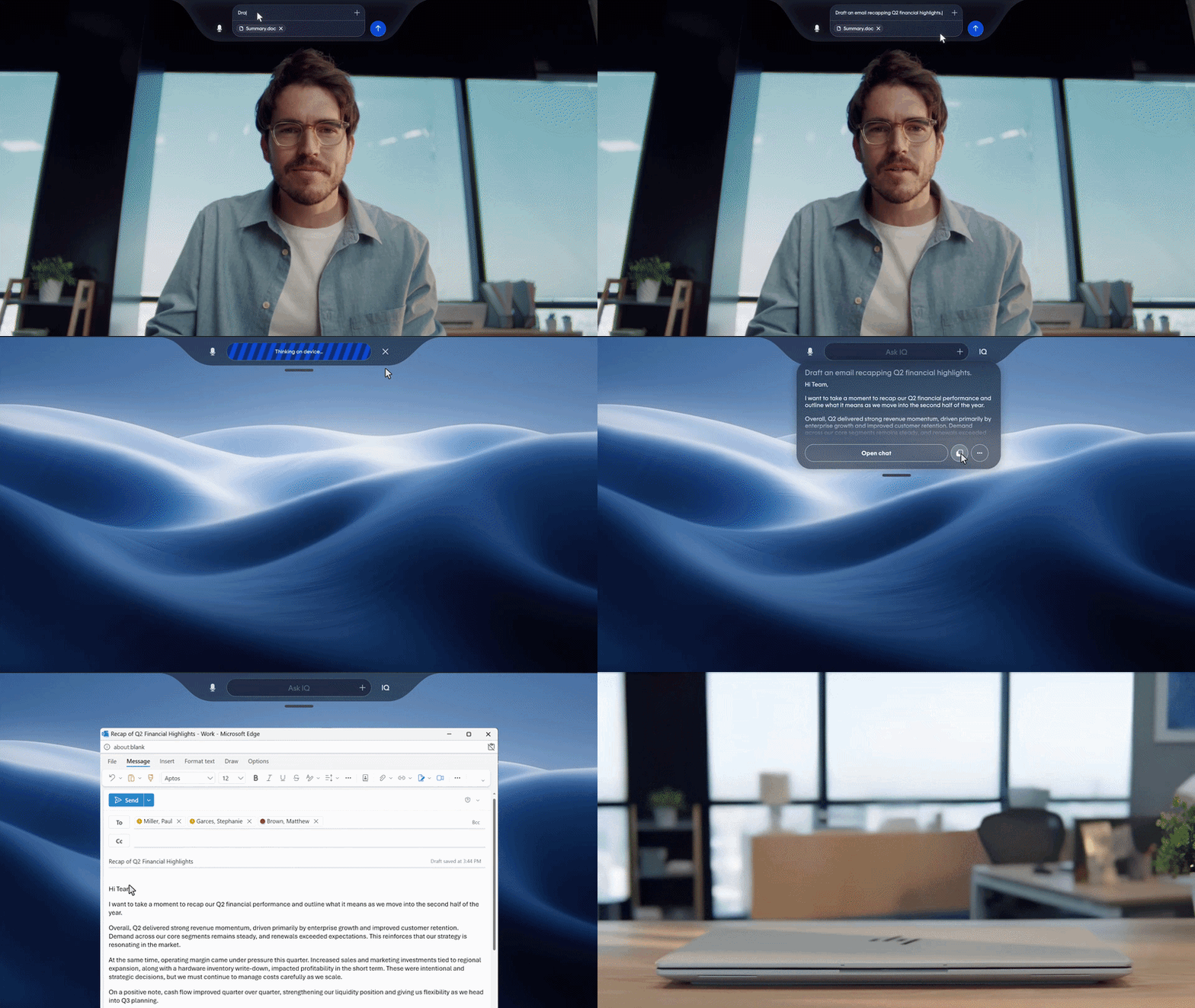
The full breadth of the product. My work spans the core design system plus enterprise, consumer, and specialized-vertical experiences, including generative AI capabilities that cut across all of them, and emerging form factors from unusual aspect ratios to display-less platforms.
Making the whole team faster
When I joined in 2025, our design-led culture was often missing a technical feedback loop. Iteration piled up delays, the brand was being developed in conjunction with the product (which meant rapid style changes rippling through everything), and most of the work lived in a single, sprawling multi-page Figma file. A lab moving this quickly generates friction faster than any individual can design around it, so a real chunk of my time goes to creative ops and design ops: the systems that keep a cross-functional team shipping.
- A design system request workflow. Every gap in the system gets evaluated against cross-functional needs, customer needs, and the current feature roadmap. The system grows deliberately, in step with where the product is going.
- A utilities and resources library. A set of components, each with variants and props, purpose-built for organizing and annotating Figma files. The single-file sprawl became structured, navigable work.
- Stewardship, jointly with brand. I'm the primary steward of our design library and partner with a design lead on the brand team to drive our identity in one direction: building equity where rapid style changes used to erode it.
- Documentation baked into components. Functional documentation lives inside the library itself, and we've begun code-connecting it so the source of truth extends into engineering.
- Handoff tooling. I noticed a recurring class of rendering errors creeping in between design and engineering, so I built developer handoff tooling that eliminates that entire category of defect. Design intent now survives the trip to implementation, for every designer on the team.
- Designers in the sprint room. Creative and dev were siloed when I started, and too much design work ended its life as pretty pictures. I pushed our design producer to get both of us into sprint planning with our engineers, and together we're establishing feedback loops where there weren't any: making the work more collaborative, cross-functional, and effective.

Stepping in as producer
When a workstream needs someone to hold the schedule, run the cross-functional threads, or coordinate creative partners, I step in as a producer or de facto manager. It's always framed by my primary responsibility: I manage so the design ships.
Shipping the reveal. HP Imagine 2026 introduced IQ to the world through Dashboard & Peek: a dashboard that drops down from the top of the screen, giving knowledge workers a new paradigm for interacting with their space, their files, and their team. Reveal dates don't move, so in the run-up I coordinated with our development partners to keep workflows clear, consistent, and thoroughly documented.
Leading a small crew. On a project bringing one of our products to a new form factor, I'm the senior designer coordinating a design engineer and an intern, and collaborating with another producer to keep our deliverables balanced between exploratory work and tactical design.
In the press
- HP Imagine 2026: HP Demonstrates Its Vision for a Connected, Intelligent Ecosystem Across Devices and Spaces with the Introduction of HP IQ
- Forbes — HP Enhances WXP And Unveils HP IQ As On-Device AI Competition Heats Up
- Introducing HP IQ | HP (YouTube)
Want the visual tour? The HP IQ section of my Work Samples covers the assistant UI, proximity experiences, and design system in depth.